Recovery after combat sports: how to return to the mat stronger


Recovery after combat sports: how to return to the mat stronger
Recovery after combat sports usually takes 24 to 72 hours. After a fight or a tough sparring session, it can take up to a week. What determines that recovery is largely up to you: how you sleep, what you eat and drink, how you schedule your rest days, and how your gym balances heavy and light training sessions. Recovery is not a break from your training. It is half of it. In this article, you will learn how long recovery takes, what works fastest, how to distinguish muscle soreness from an injury, and why the gym where you train has more influence on your recovery than you might think.
In a nutshell
- ✅ On average, a muscle group needs 24 to 72 hours to recover. Beginners should allow at least 2 days before placing heavy demands on the same muscle group again.
- ✅ Sleep is your most powerful recovery tool. For intensive training, 8 to 9 hours per night is recommended.
- ✅ Distribute your protein throughout the day and properly replenish fluids and carbohydrates after every workout.
- ✅ Active recovery, such as walking or gentle cycling, helps more than just lying on the couch.
- ✅ Sharp pain, swelling, or dark urine after heavy exertion is not ordinary muscle soreness: stop training and seek medical help.
Table of contents
- Why recovery matters more in combat sports
- How long does recovery take after combat sports training?
- The four pillars of fast recovery
- Planning rest days: can you train three days in a row?
- How do you know if you have recovered?
- Muscle soreness or injury: where is the line?
- Returning after an injury
- Our view on recovery
- Find a gym that fits your rhythm
- Frequently asked questions
- Sources
Why recovery matters more in combat sports
In most sports, you place strain on only a few muscle groups. In combat sports, you use almost everything simultaneously: explosive power for punches and kicks, endurance for the rounds, grip and core stability during wrestling, and you have to absorb impacts or break falls properly. As a result, your muscles, joints, and nervous system are all working hard at the same time.
Advertentie
This has also been measured scientifically. Researchers had fighters complete a simulated 3-round, 5-minute MMA match and observed significant fatigue and muscle damage. A marker for muscle damage (lactate dehydrogenase) remained elevated 24 hours after the bout. The stress hormone cortisol rose significantly during the fight. This means your body is still in full recovery mode even when you already feel fine again.
Nutritionist Dr. Samefko Ludidi compares recovery in an interview with the Dutch Martial Arts Authority (Vechtsportautoriteit) to car maintenance. You do not just make sure everything is in order right before the annual inspection; you maintain it continuously. Recovery works the exact same way: it does not just happen right after training, but throughout the entire day.
The good news: those who take recovery seriously improve faster. You do not get stronger during the session itself, but in the hours and days that follow.
How long does recovery take after combat sports training?
That depends on how hard you trained, which muscle groups you engaged, and how long you have been training. According to FIT.nl, a muscle group needs an average of 24 to 72 hours to recover. For beginners, it is safest to rest for at least 2 days before heavily loading the same muscle group again. Training a different muscle group the next day is perfectly fine.
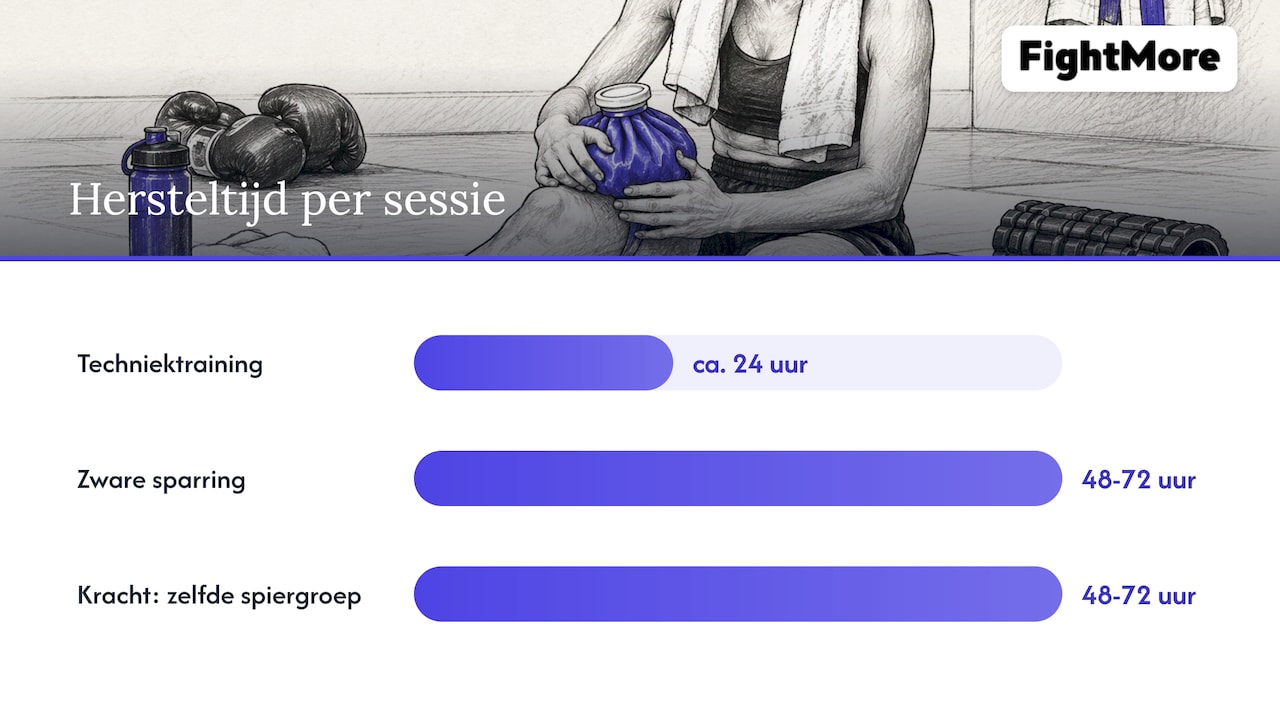
GezondNU also mentions 48 to 72 hours as the average rest period after heavy strength training, and less after a lighter session.
This overview helps you gauge where you stand:
| Session type | Typical recovery time | What you can do the next day |
|---|---|---|
| Technique training, low-intensity pad work | approximately 24 hours | Train as normal, preferably with a different focus |
| Heavy sparring or conditioning | 48 to 72 hours | Light technique, mobility, walking |
| Strength training for the same muscle groups | 48 to 72 hours | Different muscle group or active recovery |
| Competition or a tough match | approximately one week of active recovery | Walking and cycling, keeping intensity below 70% |
After a fight, Ludidi advises at the Martial Arts Authority taking a week off during which you remain active, but stay well below 70% intensity. According to him, a true elite athlete is confident enough to sometimes do nothing at all.
The four pillars of fast recovery
No gadget or supplement comes close to the fundamentals. Anyone who has these four pillars dialed in will recover faster than someone buying every product on the market. For more in-depth information, check out our article on the 4 factors that truly count.
1. Sleep: your most crucial training moment
In the summary of Recovery for Performance in Sport, sleep is labeled the most important recovery strategy we have. During deep sleep, your body produces more growth hormone for physical repair. During REM sleep, you mentally process what you have learned, which also applies to new techniques and combinations. Furthermore, sleep quality is one of the earliest indicators that you may be heading toward overtraining.
For intense athletic training, Ludidi recommends at least 8 to 9 hours of sleep. In practice, this means:
- Training late in the evening? Plan a consistent wind-down routine after class: shower, eat, screens off.
- Stick to regular bedtimes, even on weekends.
- An evening session that leaves you keyed up calls for a calm cool-down. Mental training for combat sports, such as breathing exercises, helps with this as well.
2. Nutrition: distribute it throughout the day
After training, your muscles need protein to repair and carbohydrates to replenish their energy stores (glycogen). Ludidi highlights that protein does not just belong in a post-workout shake, but spread across every meal of the day. Following a competition, focus primarily on fresh, unprocessed whole foods, and limit fast-food splurges to a single occasion.
Regarding carbohydrates, the summary of Recovery for Performance in Sport suggests 7 to 12 grams per kilogram of body weight per day following an average training day. After a heavy day, that rises to 10 to 12 grams per kilogram. A ratio of roughly 3 parts carbohydrate to 1 part protein replenishes glycogen most efficiently. These high targets mainly apply to athletes who train frequently and intensely. If you train twice a week, you will need considerably less.
An example for a 70 kg athlete after a demanding sparring evening: a bowl of pasta with chicken and vegetables, accompanied by yogurt and fruit. Afterward, spread your protein across breakfast, lunch, and snacks. If you want to know how much protein you need after exercising and when to consume it, read this overview on protein after exercise. For a full nutrition plan tailored to training and competitions, explore our guide on nutrition for combat sports.

3. Hydration: often underestimated
During intense training under hot gym lights, you lose significant amounts of fluid. According to Recovery for Performance in Sport, a 2% loss in body weight from dehydration can lead to a 20% drop in performance. To rehydrate fully, drink 150 to 200% of the fluid weight you lost.
A simple check: weigh yourself before and after a hard training session. If you are 1 kilogram lighter, drink 1.5 to 2 liters over the subsequent hours, paced steadily rather than all at once.
4. Active recovery: keep moving
Sitting completely still feels instinctive when everything aches, but it is counterproductive. Sports physiotherapist Anne van Engelen explains at GezondNU that moving gently is far better when dealing with soreness. Without movement, your muscle pump is less effective, causing your body to clear metabolic waste products more slowly. Light movement such as cycling actively supports recovery.
Great forms of active recovery on a rest day:
- ✅ 20 to 30 minutes of walking or gentle cycling
- ✅ Swimming at a relaxed pace
- ✅ Mobility work for hips, shoulders, and back
- ✅ A light technique class without sparring
Stretching to the point of pain does not belong here. Gentle mobility work is plenty. A proper warm-up prior to your next session also lowers the risk of issues: in our article on the kickboxing warm-up, you will find three complete 10-to-15-minute routines.
Planning rest days: can you train three days in a row?
Yes, you can, provided you alternate intensity levels and avoid putting maximal load on the same muscle groups two days in a row. In addition, schedule at least one full rest day per week.
Why timing is so critical is explained by Jeroen van der Mark of FIT.nl through the concept of supercompensation: after training, your body rebuilds beyond its prior baseline. If you train again at that optimal point, you get stronger week after week. If you train too early, performance drops because your body has not finished repairing. If you wait too long, you plateau at your baseline level.
Here is what a weekly schedule might look like for a beginner training three times a week:
| Day | Activity |
|---|---|
| Monday | Combat sports class (technique and pads) |
| Tuesday | Walking or gentle cycling |
| Wednesday | Combat sports class (conditioning and combinations) |
| Thursday | Mobility work, 20 minutes |
| Friday | Rest |
| Saturday | Combat sports class (light sparring or drills) |
| Sunday | Rest or a walk |
If you have just started, begin with two classes per week and only add a third once you feel fully fit after a few weeks. Experienced fighters train more frequently, but the same rule applies: the more often you train, the more crucial the balance between hard and light sessions becomes.
This is where your gym makes all the difference. A well-structured schedule featuring technique nights, conditioning classes, and sparring sessions on separate days handles most of the planning for you. A coach who notices you are fatigued and assigns you light drills instead of sparring that evening is protecting your recovery. Therefore, when choosing a gym, evaluate not only the martial art taught, but also the timetable and the quality of coaching.
How do you know if you have recovered?
Your body sends clear signals. You are generally ready for a heavy session when:
- ✅ your muscle soreness has cleared and you can move normally
- ✅ your strength is back: strikes and kicks feel explosive again
- ✅ you slept soundly and uninterrupted
- ✅ you feel eager and motivated to train
- ✅ your resting morning heart rate is at its normal baseline
Conversely, stay alert if you still feel exhausted after a full night's sleep, your performance is dipping, you feel unusually irritable, or your morning heart rate is elevated. One tough week is normal. If it persists for weeks, it could indicate overtraining. In our article on recognizing overtraining, you will learn which warning signs to look out for today.
Muscle soreness or injury: where is the line?
Normal delayed onset muscle soreness develops 12 to 24 hours after training. It feels like a dull, tight ache, diminishes once you warm up, and fades within a few days. Your strength remains intact, and there is no swelling.
An injury feels different:
- sharp or sudden pain, frequently occurring during the session itself
- pain located within a joint rather than the muscle belly
- swelling, redness, heat, or bruising appearing the following day
- notable loss of strength or a joint that feels unstable
- pain that does not ease after several days, or progressively worsens
Recognize any of these? Do not push through the workout to see if it goes away; consult your physician or a sports physiotherapist. The same applies if an identical complaint keeps recurring or your performance declines despite taking rest.
One specific scenario demands immediate medical attention: unexpectedly severe muscle pain, pronounced weakness, or dark brown, tea- or cola-colored urine following extreme exertion. These symptoms do not need to appear together. If you notice any of them, contact your doctor or an urgent care clinic immediately.
Returning after an injury
Following an injury, return to activity in progressive stages, ideally in consultation with your physiotherapist: first routine daily loading, then light exercise, followed by sport-specific drills, and only then full intensity and live sparring. At every stage, the rule remains: pain must not escalate during or after training, and the affected area must remain calm in the hours that follow.
Two pitfalls fighters often overlook:
- Painkillers before training. These mask the very warning signs that tell you whether you are moving too fast.
- Compensating. If you alter your posture or movement mechanics to avoid discomfort, you place abnormal stress on other joints. That is a clear sign to step back.
Always communicate your injury history to your coach. A good gym will adjust exercises, let you train without a partner temporarily, and ease you back into sparring gradually. This keeps you connected to your team and maintains your routine while giving your body the time it needs.
Advertentie
Our view on recovery
At FightMore, we believe proper recovery starts with picking the right place to train. Sleep, nutrition, and rest days are within your control. But whether your weekly training is intelligently structured, whether your coach notices when you are fatigued, and whether the training environment is safe depends on the gym.
That is why our priority is safety: on our platform, you will find certified gyms featuring more than 50 martial arts disciplines to choose from. Whether you are stepping into boxing for the first time, transitioning to BJJ, or finding a gym for your child, you can compare locations, read reviews, and check experiences from other athletes before ever stepping onto the mat.
We view recovery as the protector of long-term motivation. Athletes who overextend themselves burn out. Those who train, recover, and train again continuously build discipline, strength, and confidence week in, week out. Every properly recovered training session is another milestone achieved.
Jason
Find a gym that fits your rhythm
Looking for a gym with a timetable suited to your week and coaches who prioritize safety? On FightMore, you can explore and compare over 800 martial arts gyms across the Netherlands. Save your favorites and book a trial class directly.
Browse all martial arts gyms or book a trial class to experience firsthand what a session and a training week look like at your future gym.
Frequently asked questions
How long does recovery take after combat sports training?
After a light technique workout, you will generally be recovered within a day. After hard sparring or heavy strength training, a muscle group typically requires 48 to 72 hours. After a competition bout, plan for about a week of low-intensity active recovery.
Can I train with muscle soreness?
With standard muscle soreness, gentle movement is actually beneficial because it promotes circulation and aids recovery. Opt for technique, mobility, or easy cycling instead of intense sparring. If the pain is sharp, located in a joint, or accompanied by swelling, do not train and have it assessed.
How many times a week can I train as a beginner?
Twice a week is an ideal starting frequency, with at least 2 days of rest before heavily taxing the same muscle groups again. If you feel energetic after a few weeks, you can add a third session. Always keep at least one genuine rest day per week.
What helps my body recover fastest?
Adequate sleep—aiming for 8 to 9 hours when training intensely. In addition, protein spread across the day, sufficient carbohydrates and hydration, and low-intensity movement on rest days all help significantly. These fundamentals outperform any tool or gadget.
How do I know if I am overtrained?
Watch for persistent fatigue that a full night's sleep does not resolve, declining performance, insomnia, irritability, and an elevated resting heart rate in the morning. If these signs last for weeks, take extra rest and review your weekly training load with your coach.
Sources
Mixed Martial Arts Induces Significant Fatigue and Muscle Damage, J Strength Cond Res (2019)
How long should I rest between training sessions?, FIT.nl
Recovering faster after exercise: 6 facts, GezondNU
Summary: Recovery for Performance in Sport, Dutch Triathlon Federation
Muscle soreness or injury after exercise: what requires attention?, Leefstijl in de Praktijk
Protein after exercise: how much, when, and which snacks?
Recommendations
You may also like
In FightMoreby JasonLight sparren: uitleg, afspraken en veilig beginnen
Wat is light sparren? We leggen uit hoe hard je slaat, welke afspraken je maakt, welke bescherming je nodig hebt en hoe je een gym vindt waar sparren veilig gaat.
 In FightMoreby Jason
Krachttraining voor BJJ: zo word je sterker op de mat
Krachttraining voor BJJ: welke oefeningen werken, hoe vaak je traint, een voorbeeldschema en hoe je kracht combineert met rollen zonder overtraining.
 In FightMoreby Jason
Muay Thai of kickboksen: de verschillen en wat bij jou past
Muay Thai of kickboksen? Je ziet de verschillen in technieken, houding, tempo en Nederlandse regels, en je leest hoe je met twee proeflessen kiest.
What do you think of this article?
You must log in to react to this article.
Comments (0)
You must log in to post a comment.
No comments yet. Be the first to respond!