Krav Maga — Defending Against a Frontal Gun Threat

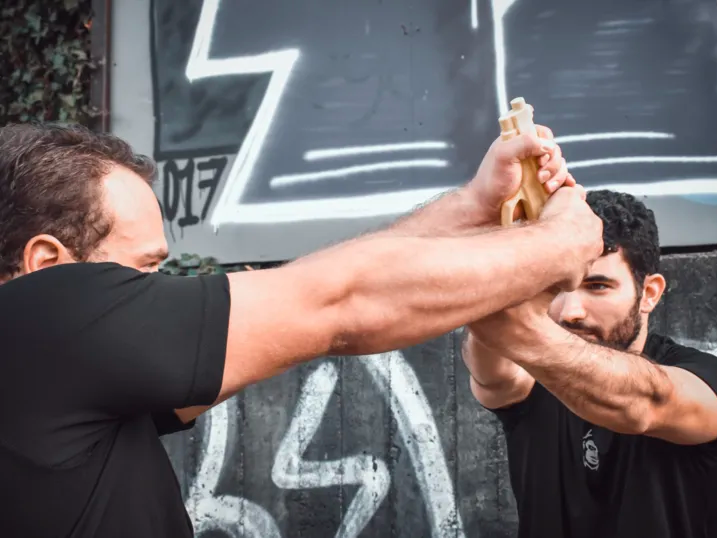
Facing a person who points a gun at you from the front is one of the most dangerous situations anyone can encounter. Krav Maga offers practical responses for this extreme scenario, but it does not treat physical defence as the default option. Avoidance, escape, or compliance to de-escalate are far safer and should be chosen whenever possible. The techniques described here are intended for last-resort self-defence only and should be learned and practised under the supervision of a qualified instructor using safe training equipment.
The basic idea (high level)
Krav Maga reduces a complex problem into a short, repeatable sequence of priorities. The sequence taught in the video you supplied is commonly summarised as: Redirect → Control → Attack → Takeaway. Each step has a clear purpose:
- Redirect: move the gun’s muzzle off the line that points to your vital areas.
- Control: secure the attacker’s firing hand and wrist so they cannot easily re-aim.
- Attack: strike to disrupt the attacker’s posture and ability to resist.
- Takeaway: remove or neutralise the weapon and create distance.
This sequence is not ceremonial — it’s a functional priority list. Executing the first element quickly reduces immediate lethality; the following steps create the opening you need to end the threat.
When (and when not) to consider these techniques
Use physical defence against a firearm only when:
- Escape or safe compliance is impossible, and
- You reasonably believe your life is in immediate danger, and
- You are prepared to accept the severe risks that come with close-quarters fighting.
Do not attempt these techniques if there is any safe alternative (running, hiding, following the attacker’s demands) or if you lack proper training.
Step-by-step mechanics (conceptual guide)
Below is a practical, mechanical description of one typical frontal gun defence. This is a conceptual guide — do not practise these moves with real firearms.
- Immediate Redirect
- As the gun is presented, move your hand quickly to the barrel/muzzle area and push or deflect it off the line of fire.
- The goal is to change where the muzzle is pointing by even a small amount. Speed here is critical.
- Turn or tuck your head slightly to lower your profile.
- Establish Control
- Hook, roll, or cup the attacker’s wrist/hand to control the firing hand. A common control method is to roll their knuckles forward and pin the wrist toward their hip.
- Use your body — hips, feet and angle — to create leverage. Don’t rely only on arm strength.
- Powerful Disruptive Attack
- While the attacker's hand is controlled and the muzzle is redirected, strike decisively to a structural target (ribs, forearm, face, or throat depending on distance and legal/ethical constraints).
- Drive the strike from the hips so you use whole-body power, not just your arm. A well-timed, hard strike breaks posture and reduces the attacker’s ability to resist.
- Break Grip & Take the Weapon
- Immediately after destabilising the attacker, manipulate the fingers and wrist to break the grip and remove the weapon.
- If you are trained and it is safe, clear the weapon (make sure it cannot fire) and secure it so the attacker cannot regain control.
- Assess and Exit
- Quickly check for secondary attackers or threats, move to cover, and call for help. The objective after disarmament is safety, not further engagement.
Practical coaching cues (short, actionable)
- Act fast. The redirect must be immediate. Hesitation kills.
- Redirect first, grip second. Change the muzzle direction before trying to control the hand.
- Use structure. Anchor into your legs and hips; use leverage on the wrist.
- Punch from the hip. Let your lower body generate power.
- Keep the muzzle away. Never allow the muzzle to return between you and the attacker’s centerline.
Common mistakes to avoid
- Freezing or overthinking. Delay is often lethal.
- Grabbing the barrel. Trying to hold the barrel or muzzle can fail catastrophically. Redirect, then control the hand.
- Relying on raw strength. Good structure and timing beat a muscular tug.
- Practising unsafely. Never use a real or loaded firearm in practice; always use inert training guns and strict safety oversight.
How to learn this safely (training progression)
A responsible training program builds skills gradually:
- Foundational drills: stance, footwork, hip-driven strikes, and partner control work.
- Controlled partner drills: wrist controls, small-scale redirects using training props.
- Training guns: inert pistols used at reduced speed to practise timing and mechanics.
- Reaction and resistance drills: increase speed and pressure progressively while keeping safety measures in place.
- Scenario work: supervised, realistic simulations that integrate decision-making, movement, and environmental awareness.
Always train with a certified instructor and safety officers. Wear appropriate protective equipment and use only training tools designed for firearm defence practice.
Legal and ethical considerations
Using force has serious moral and legal consequences. Self-defence laws vary widely by country and region; in many jurisdictions, the use of potentially lethal force is only justified when a person reasonably believes they face imminent death or serious bodily harm. If escape is possible, it is frequently the legally and ethically preferable option. Before applying any technique, understand your local laws and the potential repercussions of using force.
Short summary
Krav Maga’s frontal gun defence is a fast, prioritized sequence: redirect the muzzle, control the attacker’s hand, attack to disrupt, then take away the weapon. These steps are designed to reduce immediate lethality and create an opportunity to remove the threat. Because the risk is extremely high, these techniques are a last resort and must be learned progressively under certified supervision, using safe training equipment and an awareness of legal responsibilities.
Want to start practacing Krav Maga?
Find a school near you

Ook iets voor jou?
In FightMoredoorDennisWhat Are the Differences Between IKMF and KMG?
Deciding between IKMF and KMG for Krav Maga? Unlock the secrets to self-defense mastery! Discover their unique philosophies and find your perfect fit today!
 In FightMoredoorIvo
Is It True That Martial Arts Are Useless in a Street Fight?
Can martial arts save you in a street fight? Discover the shocking truth behind their effectiveness, what styles truly prepare you, and why avoidance is the ultimate survival skill!
 In FightMoredoorJason
Krav Maga Stick Defense
One hit from a stick can be deadly! Discover how Krav Maga transforms this terrifying threat into a chance for survival. Don’t miss the ultimate self-defense techniques!
Wat vind jij van dit artikel?
Je moet inloggen om te reageren op dit artikel.
Reacties (0)
Je moet inloggen om een reactie te kunnen plaatsen.
Nog geen reacties. Wees de eerste die reageert!